
Wasting money on Facebook ads that do not convert is a common frustration for many marketers. The solution is not a bigger budget, but a smarter strategy. A systematic Facebook ad testing process is the key to unlocking consistent results, allowing you to understand what truly works for your audience. This guide provides a clear, step-by-step framework to help you test effectively, lower costs, and scale your winning campaigns with confidence.
Contents
The foundation of a successful ad testing strategy

Before spending a single dollar, understand that a methodical Facebook ad testing process is not optional. It is the very foundation of profitable advertising. This strategic framework separates campaigns that thrive from those that merely survive on luck. Its core purpose is to replace assumptions with data, allowing you to identify what truly resonates with your audience. This systematic improvement ensures your budget is invested, not wasted, leading to sustainable growth.
- Risk Mitigation: Testing with small budgets first is your primary defense against large-scale losses. It allows you to validate creative concepts and audience targeting before committing significant resources, protecting your overall marketing spend.
- Informed Scalability: It provides a clear, data-backed path to expansion. Once you identify winning ads, you have a proven formula. This is crucial for understanding how to scale Facebook ads without seeing a sudden drop in your return on ad spend (ROAS).
- Continuous Improvement: The digital marketplace is never static; audience preferences evolve. A continuous testing culture ensures your messaging remains sharp and effective, helping you adapt to changes and consistently improve quality ranking in Facebook ads.
Key variables to test in your Facebook campaigns
To run an effective test, you must isolate variables. This is the core principle of a successful Facebook ad testing process. Testing too many elements at once makes it impossible to know which change drove the results. A disciplined approach, often called split testing, focuses on changing one key variable at a time while keeping all other elements constant. This method provides clean data to guide your decisions.
- Creative: This is often the highest impact variable. Test different images, videos, carousels, or ad formats. A single powerful visual can drastically alter your results and is a primary focus for performance improvement.
- Audience: Test different interest groups, lookalike audiences, or demographic segments. Discovering a new, high-performing audience can unlock significant growth and improve your return on investment.
- Ad Copy: Experiment with your headline and primary text. Test different hooks, value propositions, and calls to action. Learning how to write attractive Facebook ad headlines can significantly boost response rates.
- Placement: Analyze where your ads appear, such as the Facebook Feed, Instagram Stories, or the Audience Network. User behavior varies greatly between placements, affecting your costs and conversion rates.
A step by step guide to setting up your test
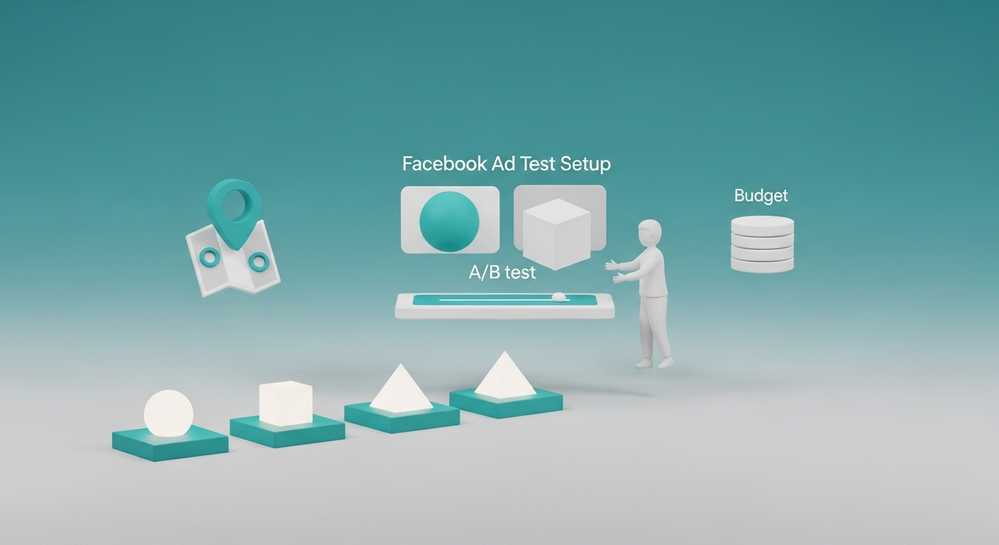
A well-structured test begins with a clear plan. Randomly launching different ads is not a valid Facebook ad testing process; it is gambling. Follow these steps to create a controlled environment that will yield clean, actionable data. This methodical approach is essential for making informed decisions and optimizing your ad spend effectively.
Formulate a clear hypothesis
Start with a specific question you want to answer. For example: “Will a video creative achieve a lower cost per purchase than a static image for my target audience?” A clear hypothesis defines precisely what you are testing and what success looks like. This clarity prevents misinterpreting the results later on.
Structure your campaign for testing
The best way to do this is by using separate ad sets within a single campaign. To test two audiences, create one campaign with two ad sets. Each ad set should target a different audience but use the exact same ad creatives and copy. This ensures you are isolating only the audience variable for a fair comparison.
Set an adequate budget and timeline
Your test needs enough budget and time to exit the learning phase and gather statistically significant data. A budget that is too small or a test that is too short will produce unreliable results. Aim for at least 50 conversions per ad set before making a decision, and consider the undefined to optimize your schedule.
Analyzing results and making data driven decisions

Once your test concludes, the analysis phase begins. This is the most critical part of the Facebook ad testing process. Dive into Facebook Ads Manager to determine a winner based on your initial hypothesis and key performance indicators (KPIs). This step turns raw data into actionable intelligence for your campaigns.
- Focus on your primary goal: If your objective is conversions, then Cost Per Conversion is your key metric. Avoid being misled by vanity metrics like a high click-through rate (CTR) if they do not lead to actual sales or leads.
- Demand statistical significance: A small performance difference is often just random chance. A true winner must outperform the other by a clear, consistent margin. If results are too close, the test is inconclusive.
- Document all learnings: Every test provides a valuable insight, regardless of the outcome. Keep a simple log of your hypotheses and results. This log becomes an essential asset for planning future campaigns.
Once you identify a clear winner, act decisively. This means knowing undefined that underperform. You can then reallocate the budget to the winning ad or use it as the control for your next test.
Common mistakes to avoid in your testing process
Even experienced marketers can fall into common traps that invalidate their results. Being aware of these pitfalls is the first step to ensuring your Facebook ad testing process is efficient and accurate. Avoiding these errors will save you time and money while providing much clearer data for your decisions.
- Testing too many variables at once: This is the most common mistake. If you change the image, headline, and audience in one test, you have no idea which element caused the performance change. Always isolate one variable per test.
- Ending the test too early: Ad performance fluctuates daily. You must let a test run long enough to get past initial volatility and gather sufficient data. Making decisions based on one or two days of data is a recipe for failure.
- Ignoring the learning phase: Facebooks algorithm needs time and data to optimize ad delivery. Making changes or ending a test while an ad set is still in the learning phase leads to skewed, unreliable conclusions.
- Using a budget that is too small: A tiny budget will not generate enough data for the algorithm to optimize. It also prevents you from making a statistically significant decision. Ensure your budget allows for at least 50 optimization events per variation.
Mastering the Facebook ad testing process transforms your advertising from a game of chance into a predictable engine for growth. It is a continuous cycle of hypothesizing, testing, learning, and iterating. By implementing this disciplined approach, you gain the insights needed to scale effectively and maximize your return on investment. Ready to run campaigns without limits? Rent Facebook Account now and apply these powerful testing principles.