
Tired of wasting your budget on Facebook ads that do not deliver? The key to unlocking profitability is not a bigger budget, but a smarter strategy. A systematic Facebook ad testing process allows you to identify what truly resonates with your audience. This guide breaks down the exact steps to test effectively, helping you move from guesswork to data-driven decisions and achieve a higher return on ad spend.
Contents
What is a Facebook ad testing process

What is a Facebook ad testing process?
A Facebook ad testing process is a systematic method for discovering what truly resonates with your audience. Instead of guessing which ad creative, copy, or targeting will work, you use structured A/B testing to compare versions. This allows you to make data-driven decisions, turning your ad spend from a gamble into a calculated investment for maximum return.
The primary goal is to isolate one variable at a time and measure its direct impact on your key performance indicators (KPIs). By focusing on metrics like cost per acquisition (CPA) or return on ad spend (ROAS), a successful process delivers clear business advantages.
- Gain a deeper understanding of your customer’s preferences and behaviors.
- Consistently lower your customer acquisition costs over time.
- Increase conversion rates and overall campaign profitability.
- Build a scalable advertising system for long-term, predictable growth.
Key elements to test in your Facebook ads
To run an effective test, you must decide what to test. Trying to test everything at once leads to confusing data and wasted budget. Instead, focus on isolating one variable at a time within core categories like creative and audience, as these often have the highest impact on the entire Facebook ad testing process.
Creative elements
Your ad creative is the first thing a user sees, offering the biggest opportunity for performance gains. Test different formats to see what captures attention. This includes comparing static images to videos, testing long-form versus short ad copy, or experimenting with different attractive Facebook ad headlines. Also, test Call-to-Action buttons like Shop Now versus Learn More.
Audience and placement
Reaching the right people is just as critical as having the right message. Test different audience segments to discover new customer groups. You can compare interest-based audiences to Lookalike audiences or test broad targeting to see if Facebooks algorithm can find your ideal customer efficiently. Similarly, test where your ads appear, such as comparing the performance of Feeds versus Stories to optimize delivery.
How to structure a simple and effective ad test
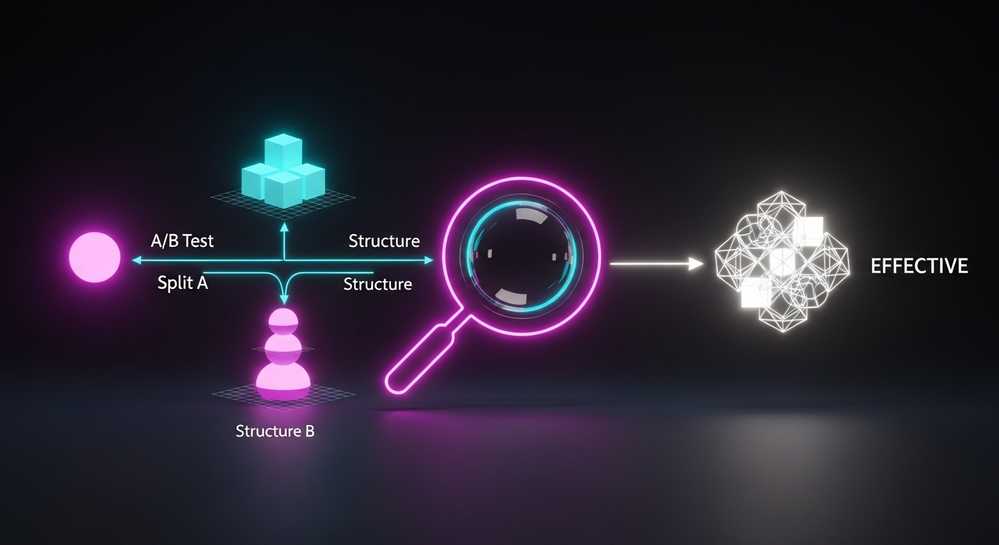
A successful test requires a clean structure to ensure your results are reliable. The most common and effective method is A/B testing, also known as split testing. Always begin by formulating a clear hypothesis. For example, a belief that a video creative will achieve a lower cost per purchase than your best-performing static image. This gives your test a defined purpose.
The golden rule of the Facebook ad testing process is to isolate one variable. If you are testing a video against an image, keep the ad copy, headline, and audience exactly the same for both ads. Changing multiple elements at once makes it impossible to know what caused the change in performance, rendering your test useless.
Use a dedicated campaign for your test with Advantage Campaign Budget or identical ad set budgets for fair delivery. Finally, establish a clear naming convention. A name like `Test_VideoVsImage_LAL1-Purchasers_US` helps you analyze results easily. This organization, right down to how you change the ad account name, is vital for long-term clarity.
Analyzing results and determining a winner

Once your test has run for a sufficient period, typically 3-7 days, it is time to analyze the data. Avoid making decisions based on just one or two days of performance, as results can fluctuate significantly. Patience is crucial for gathering reliable data that leads to a conclusive outcome in your Facebook ad testing process.
Focus on the primary metric that aligns with your campaign objective. If your goal is conversions, Cost Per Purchase (CPA) and Return On Ad Spend (ROAS) are your most important metrics. For a traffic campaign, you would focus on Cost Per Click (CPC). Knowing undefined provides a benchmark for success.
- Cost Per Result: The main indicator of efficiency for your specific goal.
- Return On Ad Spend (ROAS): The most critical metric for e-commerce profitability.
- Click-Through Rate (CTR): A strong measure of how engaging your creative is.
Declare a winner only when there is a clear and statistically significant difference in your main KPI. A small 5% difference may not be conclusive, but a 30% lower CPA is a strong signal to act upon. This data-driven approach is the core of effective advertising.
Scaling winning ads and iterating on your learnings
Identifying a winning ad is a milestone, not the finish line. The next crucial step in the Facebook ad testing process is to capitalize on this success. This involves two key actions: strategically scaling the winner and iterating on your learnings to inform future tests. This transforms a single win into a long-term advantage.
Scaling your winner
Once you have a clear winner, the goal is to show it to a larger audience. However, you must scale the budget carefully to avoid disrupting Facebooks algorithm and resetting the learning phase. A sudden large increase can cause performance to decline. The best practice is to gradually increase the budget of the winning ad set or campaign by 20-30% every 48 hours, while closely monitoring performance.
Iterating on your learnings
Your test results provide invaluable insights that go beyond a single campaign. If a video ad outperformed an image, your next test could compare two different video styles. If a specific audience responded best, try testing new ad copy for that same audience. Each test should build upon the last, creating a continuous cycle of improvement that steadily enhances your overall account performance.
A disciplined Facebook ad testing process transforms your advertising from a gamble into a predictable system for growth. By consistently testing, analyzing, and scaling, you build a deep understanding of what works for your brand. This iterative approach is the ultimate key to long-term profitability. Ready to run campaigns without limits? Rent Facebook Account and apply these principles today.